
| Impacts |
| Biodiversity, amenity/recreation |
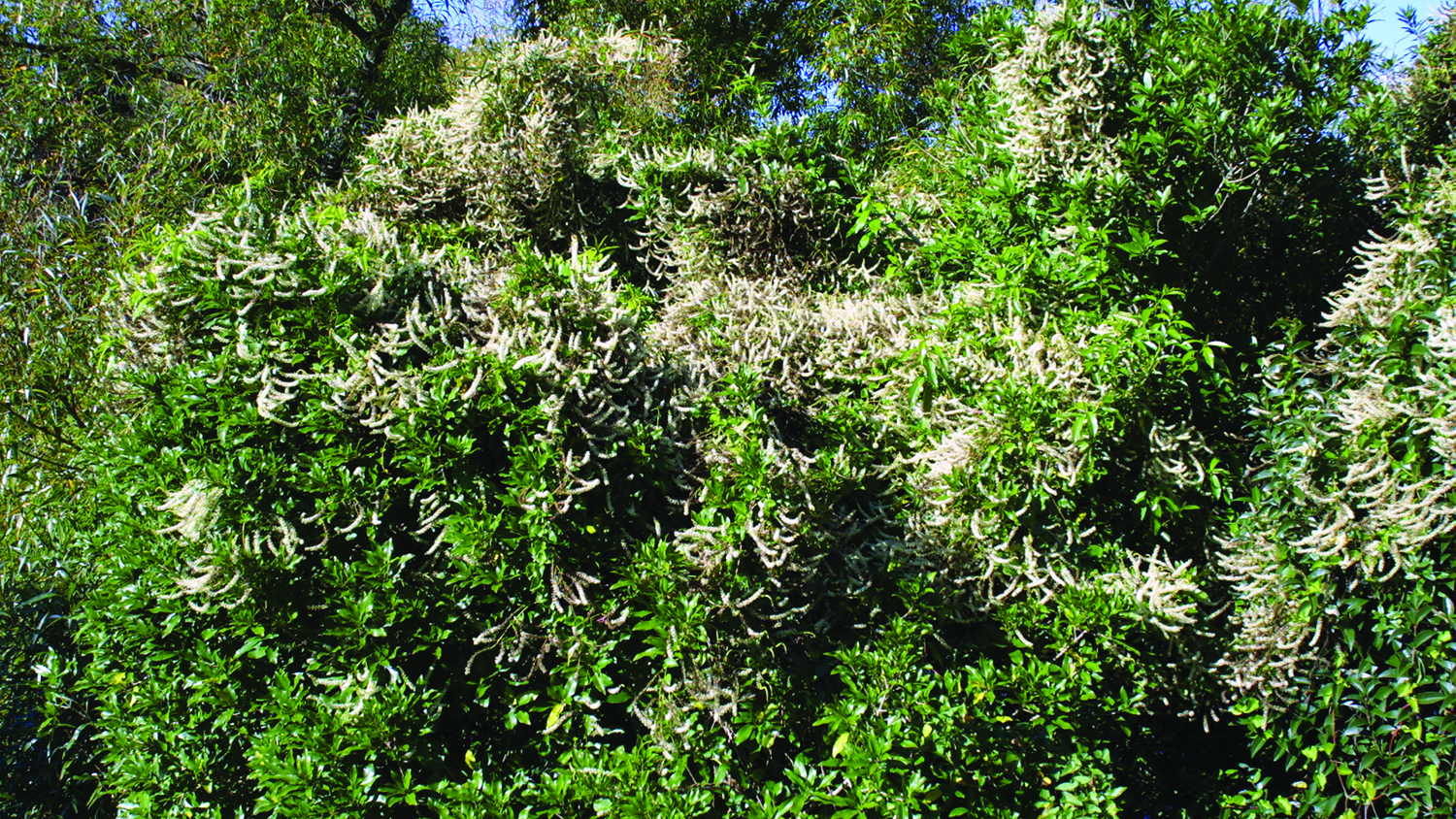
Mignonette vine, originally from South America, was introduced to New Zealand as an ornamental species. It has escaped from gardens and become a weed in urban reserves and gardens, shrublands, and along waterways and forest margins.

What does it look like?
Perennial, climbing, hairless woody vine.
Flowers
- Numerous tiny, pungent cream flowers in long (18cm) narrow flower heads (racemes).
- Flowers are present in late summer to early autumn.
Fruit/seeds
- No fruit is produced in New Zealand.
Leaves/stems
- Leaves slightly succulent/fleshy, heart-shaped, and shiny.
- Leaves grow alternately along the stems.
- Slender stems, often reddish aging to dull brown.
- Stems often have small ‘irregular’ warty aerial tubers.
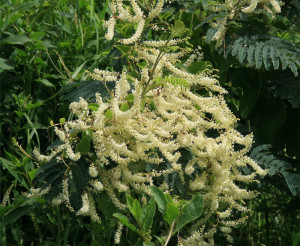
Photo credit: Trevor James
Why is it a pest?
Mignonette vine, a garden escape, thrives in warm, moist climates and on fertile soils. It can rapidly climb over and smother desirable plants, killing them by blocking out light and toppling smaller trees with its thick, heavy blanket of growth. It can also grow over fences and hedges, blanketing them with its vines.
Although it doesn’t produce any seed in New Zealand, mignonette vine can readily grow from even small fragments of its aerial tubers or rhizomes (roots). It spreads mainly via these fragments in illegal or inappropriately dumped garden waste.

Control methods
Physical control
- Remove all underground and stem tubers and burn, or take the whole plant to a refuse transfer station. Home composting will not kill mignonette vine.
- Remove every scrap of vine from affected trees and shrubs. Any stems or tubers touching the ground will regrow, so be careful not to drop any when moving them.

Photo credit: Forest & Kim Starr
Herbicide control
Stem scraping
- Use a sharp knife to carve away the outside of a stem, removing about a third of its diameter.
- Apply herbicide immediately.
- Gouge tubers carefully and apply herbicide.
- Do not remove the roots from the soil or the treated vine until the stems are quite dry (6-12 weeks, depending on weather).
Cut vine treatment
- Slash vines at ground level and immediately paint herbicide* on both stem sections. Use a squeeze bottle to apply herbicide to avoid splashes.
- Swab hanging ends of the vine and use a dye to keep track of stumps.
- Pull out and rake up all aerial tubers, then burn.
*Note: If picloram gel is used, best results are achieved during periods of active growth (November to April). Cut the stem 50-100mm above the ground before applying, instead of at ground level.
Spray application
Best results are achieved between January and April.
- Control large infestations by cutting back the top growth to 2m and spraying all leaf surfaces on remaining stems.
- Protect surrounding plants by cutting back any growth covering the vine before spraying.
- Dispose of cut growth at a refuse transfer station.
- Monitor closely and repeat spray as regrowth appears.
Safety when using herbicides
- Follow the instructions on the manufacturer’s label.
- Always wear protective clothing.
- Always minimise the risk to your other plants.
- Contact the supplier for further advice.
Summary of herbicides and application methods for control
| Herbicide | Application |
| Triclopyr/picloram mix | Cut vine treatment. |
| Picloram gels | Cut vine treatment. |
| Glyphosate gels | Cut vine treatment. |
| Glyphosate | Cut vine treatment, stem scraping. |
| Metsulfuron application | Cut vine treatment/spray application. |
| Triclopyr application | Cut vine treatment/spray application. |
| Clopyralid | Spray application. |
| Herbicide rules will apply. You may need to notify neighbours if spraying. The Waikato Regional Plan explains the agrichemical (herbicides) use rule in section 6.2 | |
More information
Advice
- For additional information and advice on control methods, call our pest plant staff on freephone 0800 800 401.
- Chemical company representatives, farm supply stores, garden centres or the Weedbusters website can also be good sources for advice.
Publications
- The following publications are available for download or from Waikato Regional Council. Contact us to request a copy (freephone 0800 800 401).

