
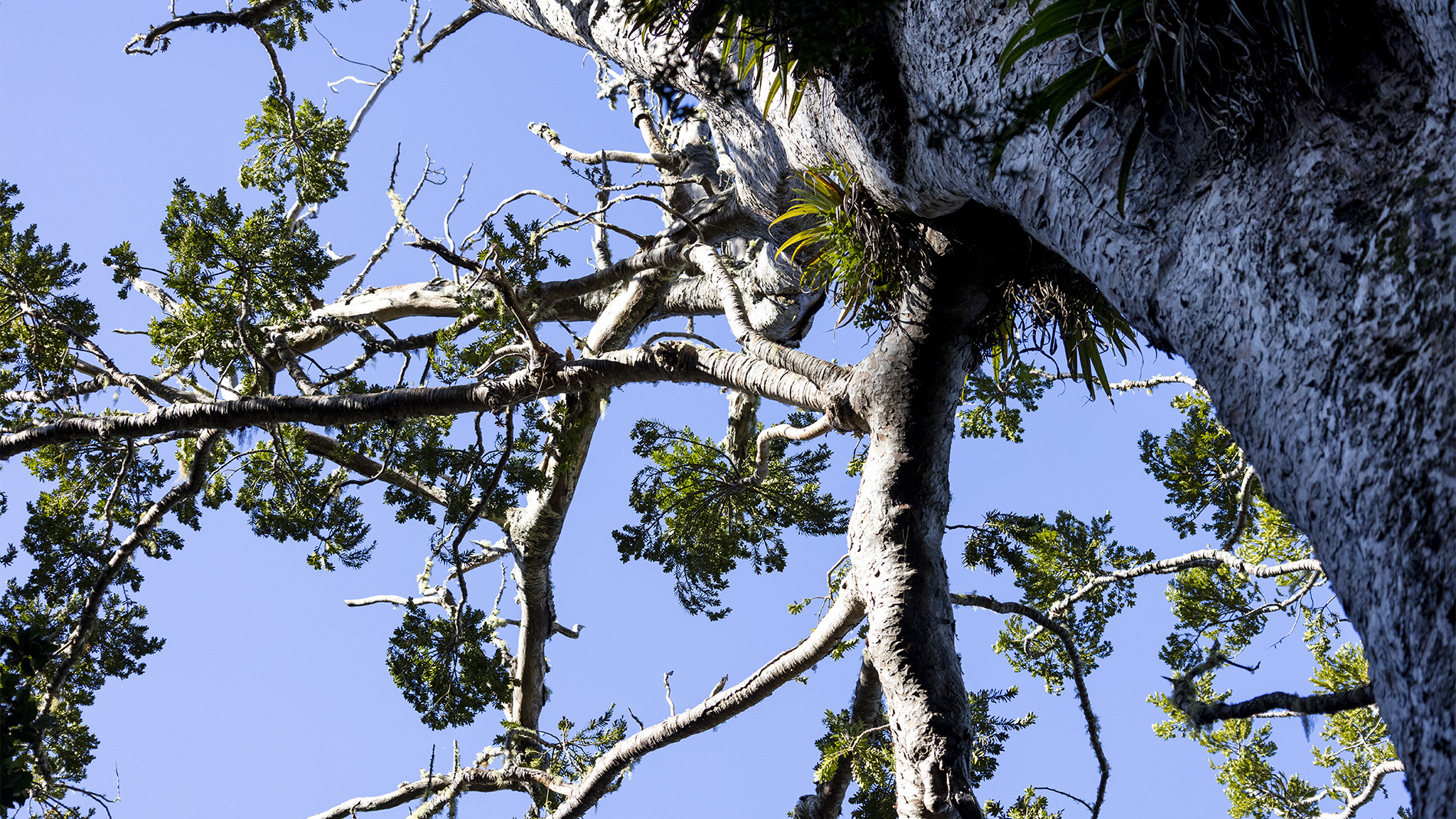
Kauri are a taonga (treasure) of Aotearoa New Zealand and the third largest conifer in the world. Living for 600 years on average and growing to immense proportions, Kauri are ‘ecosystem engineers’, creating habitats and homes for our native species, including plants, birds and insects.
Kauri grow naturally in Northland, Auckland, Waikato (which includes the Coromandel Peninsula) and the Bay of Plenty regions.
Kauri forests used to cover more than a million hectares of Aotearoa but due to extensive logging in the 1800s, less than 1 per cent of original Kauri forests remain.
The threat to kauri
 Kauri are threatened by a soil-borne pathogen called Phytophthora agathidicida (PA for short).
The PA pathogen infects kauri trees through their roots and restricts the transportation of water and nutrients between the roots and the leaves, eventually starving kauri. This causes the condition known as kauri dieback disease.
There is no proven way to cure a kauri tree that has been infected by the PA pathogen, and there are limited treatment options.
To date, PA has been detected in the Northland, Auckland and Waikato regions, but we do not yet know how many kauri trees have been infected by it.
In response to the threat to kauri, a National PA Pest Management Plan was launched in 2022. The national plan introduced 10 rules to help kauri from the PA pathogen.
The rules apply to you if you:
- have kauri on your property
- go into a forest with kauri
- grow kauri trees
- own farm animals that graze around or in kauri forests.
You can read the national plan rules here.
Recognising the symptoms
It may take years for physical symptoms to appear but, over time, a kauri tree that has been infected by PA will display yellowing leaves, a thinning canopy, dead branches and bleeding gum.
If you see a kauri in the Waikato that appears to be sick, please report it to Waikato Regional Council and provide images so the Kauri Protection programme can investigate whether it is likely to be infected by PA. Not all sick-looking kauri are suffering from PA but the only way to confirm whether a tree is infected is through sampling and analysing the soil around them.
What can you do to help kauri
Prevent the spread
Kauri infected by PA are not widespread in the Waikato region. The survival of kauri depends on all of us taking action to stop the PA pathogen from spreading. Here are some simple steps you can take.

AVOID
Keep people, vehicles, equipment and stock away from the kauri root zone, which is three times the drip line of the tree and a susceptible area for PA.

SCRUB
Scrub all the dirt from your gear, before entering and exiting a kauri forest.

CHECK
Check that all dirt has indeed been removed after you have scrubbed your gear.

SPRAY
Spray your gear with disinfectant after scrubbing and checking for dirt.


STAY
Stay on the track to avoid kauri root zones.
Kauri on your farm?
Stock and farm animals can carry the PA pathogen in soil on their hooves and coats. Help prevent the spread of PA by keeping stock out of kauri forests. The kauri team at Waikato Regional Council may work with landowners to fence out stock from high risk areas. Contact the team for advice or to find out how they can help. Phone 0800 800 401 or email kauri@waikatoregion.govt.nz
Volunteer and community groups
We help provide kauri protection information and education to community and iwi predator control and restoration groups, LANDSAR and tramping clubs, or any group undertaking activities within kauri forests. This includes training in correct hygiene protocols when working near kauri areas and helping groups develop and implement kauri protection plans as required under the National Plan for Kauri rules. Phone 0800 800 401 or email kauri@waikatoregion.govt.nz
